Register Now for Mushroom Education Day
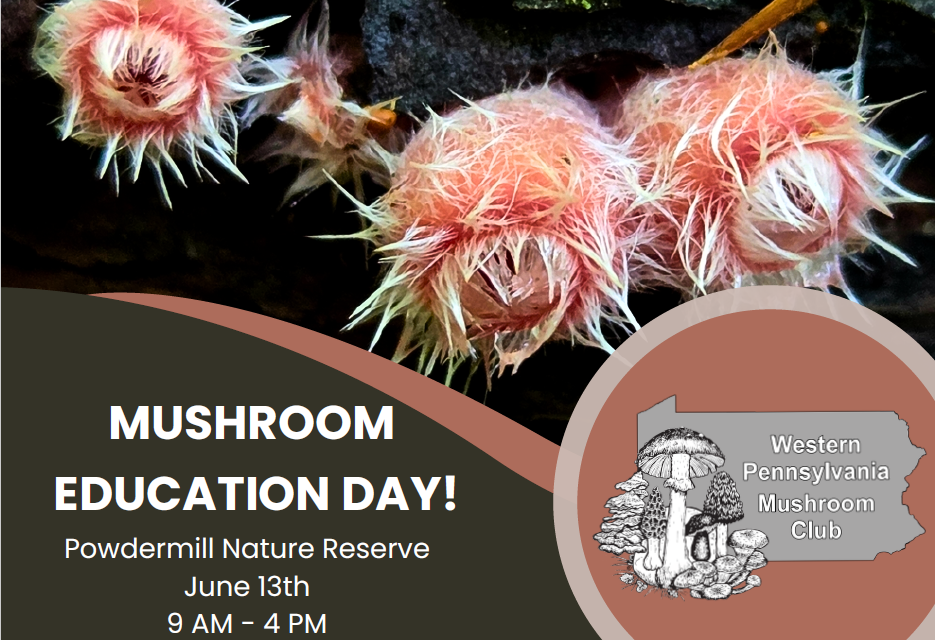
Registration is now open for Mushroom Education Day on Saturday, June 13, at Powdermill Nature Reserve in Westmoreland County. There is an information flyer with summary and the full schedule here:
9:00-9:30 a.m. – Registration
9:30-10:30 a.m. – Stephen Bucklin
An Introduction to Pennsylvania Fungi & their Relationship with Birds
Fungi shape and connect our world, so naturally they form unique and fascinating symbiotic relationships – both parasitic and mutualistic – with different groups of organisms. Ornithomycology is an emerging field that studies the ecological relationships between fungi and birds. In this presentation, Stephen will review basic fungi biology and ecology and shed light on what we know so far about these relationships in North America’s forests.
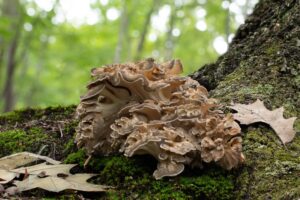
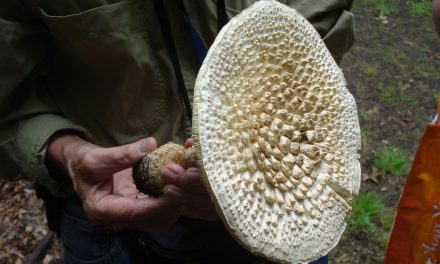
Hen of the Woods (pictured) embodies a web of relationships that includes birds – beyond the similarity of their physical resemblance to a chicken with ruffled feathers. A potential parasite of oaks and other broadleaf trees, Grifola frondosa plays a role in creating standing dead trees used by birds for nesting cavities and foraging for wood-decay invertebrates. A millipede crawls along the pore surface of a frond munching away, creating an energetic link between the mushroom and whatever thrush, turkey, grouse, or other ground-foraging bird may eat them.
10:40–11:40 a.m. – Barbora Batokova:
Know What You’re Picking: Edible Mushrooms and Their Lookalikes
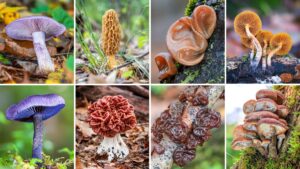
Some of the most sought-after edible mushrooms also happen to have some convincing—and sometimes dangerous—lookalikes. And while many foragers learn to recognize a few “safe” species, the real skill lies in understanding what you’re comparing them to.
In this presentation, we’ll take a closer look at some of the most commonly confused edible mushrooms and their lookalikes and break down how to tell them apart using clear, practical features you can actually use in the field.
We’ll explore real-world comparisons like true morels vs. false morels, blewits vs. webcaps, wood ears vs. other jelly fungi, oyster mushrooms vs. angel wings and oysterlings, or honey mushrooms alongside their toxic lookalikes such as Galerina marginata and Hypholoma fasciculare.The focus is on the subtle—but critical—differences that separate a confident ID from a risky guess. If you’ve ever hesitated over a mushroom that “looks right” but didn’t feel certain, this talk will give you the tools to slow down, compare with confidence, and make more informed decisions in the field.
11:40 a.m.–12:30 p.m. – LUNCH ON YOUR OWN
12:30–1:30 p.m. – Dawn Wehman
Better Fungal Photography for iNaturalist

Ready to take your mushroom observations to the next level? Join Dawn Wehman for a fun and practical session designed for users who already love sharing their finds but want to make them truly count. Learn how small changes—like capturing key features, improving lighting and focus, and following a simple field workflow—can turn an unidentifiable snapshot into valuable data that contributes to science. We’ll look at real examples, common mistakes (we’ve all made them!), and tips on thinking like an identifier to help you contribute more meaningfully to iNaturalist.
Attendees should have the iNaturalist app downloaded on their phone and are encouraged to watch our iNaturalist 101 video in advance to get the most out of the session. Whether you’re a casual observer just getting started, working toward your Button Program goals, or an amateur photographer with a DSLR, this session offers something for everyone.
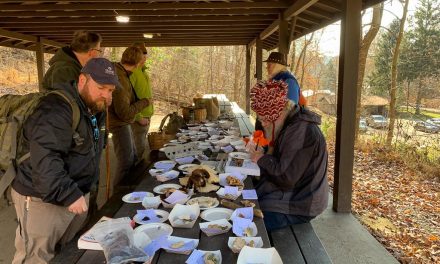
1:45–3:30 p.m. – Walks/ID table
Identifier-led walks to explore the fungal diversity on Powdermill’s trails!
3:30-4:00 p.m. – CLEANUP
Registration is required to attend the lectures and walks.
The cost is $35 for WPMC members; $45 for non-members.


Recent Comments